
|
Science fiction
has been the popular cinema genre best placed to challenge the ways in
which people see each other in modern societies. Costume usually indicates
gender and status through shape. This is all most cultures have us notice
of each other. But in making people imagine urban futures, could images
help us learn to experience each other differently?
Responses to women have been a keystone in our social brickwork. The power of images here, is shown by the impact of Christian Dior on the design of post war woman; and consequently post war man! Picasso - A Starting Point? Cubism, Picasso and Braque, started trends in which art students of their era learned to paint human figures so as to obscure body outline. The typical cubist portrait was a vague outline filled with sharp details of the subject in a necessarily narrow range of colour. Two Soviet women who trained in such technique tried to develop fabric patterns in this effect for everyday clothes. Popova and Stepanova had tried to produce patterns that even gave the illusion of movement when the wearer was sitting still. Both women applied their ideas to the design of mass fashion. For the USSR they knew that these must be work overalls and 'sports overalls'. Uniforms for a community dedicated to production. As with the monastic habit, such dress means that one has to get to know one's colleagues after the superficial distinctions have been down played. Fascination with abstraction and indeed optical illusion, had been the basis of art and decoration before - in Islam. Western painters since the Great War, had experimented with collections of coloured shapes. The colours of these shapes could defy the viewer's ability to imagine them positioned in even an abstract landscape. (e.g. Kandinsky, Malevich, Mondrian and Pollack.) But film-makers have tried to make narrative images quickly readable. Film Follow Up In cinema, costume on sets of very similar colour tones, or indeed tinting, can give a sense of abstraction more than just about status and gender styles. (e.g. Performers can be lit in such a way that one cannot always tell where flesh ends and costume begins.) Body outline can be obscured, and thus film-makers can choose how to reveal it. The film-makers' use of 'Close Ups' means that they can further present the human form in this manner. Soviet films in particular came to consist of relatively excessive numbers of facial close ups. However, for much of its history the film has presented the human form in quickly recognisable forms. Set design played a far bigger part in film making in the era of silent black and white than today. One only has to remember German Expressionism. This movement inspired the sets in Fritz Lang's Metropolis (1926). But this was not the first film to present possible futures. Aelita (1924) directed by Yakov Protazanov, like Schwarzenegger's Total Recall (1990), involves scenes in a Martian society. This Soviet film had sets designed by excessively modernist Cubo-Futurists. Such framing and design could have been used by film to evade committing support to standard representational codes. But it has been Scandinavian Protestant rather than eastern Communist films that did this! The Danish director Carl Dreyer's The Passion of Joan of Arc (1928) and Ingmar Bergman's Persona (1966) are films that particularly work with such evasion. Soviet film has no such examples. (This despite the whole of the Soviet avant gard being obsessed with Chaplin's mixing of traditional articles of clothing to baffle normal expectation.) Urbanisation Stalls These artistic developments in the twenties coincided with a developing SF/Fantasy audience among young men. (This was largely supplied by comics and magazines.) Cinema might have helped such audiences, who were still only becoming literate, explore openings in new city life. Over the next couple of decades, however big parts of the third world were coming under the leadership of Mao and Gandhi. Both stood for rejection of the urbanisation suggested by the northern world. Hollywood had shown the world the American way. For most of the world this bears the same relationship to everyday life as SF does to the lifestyles of us in advanced urban society. However the Hollywood cinema as a whole cannot be said to have been positive about the new urban life. Strangely when the new Soviet Regime began making its own films it went into historical epics of the revolutionary battles of preceding decades (Eisenstein and Pudovkin). Any desire to follow up the futuristic Aelita was immediately overwhelmed by this historical cycle. The Film That Could Have Been Star Wars (1977) set out to resemble the thirties serial Flash Gordon. If you look at it carefully you notice that it could almost be a black and white film with a bit of the tinting seen in the twenties. In doing so it suggests how the aesthetics of that era could have been mobilised, and is a critique of those times. Despite the scantily clad image of Carrie Fisher on the Barbarella-like publicity poster, Princess Leia is not shown to emphasize her body. In fact our first glimpse of her is in a scene that underlines her lack of visibility. As her ship is attacked by Darth Vadar she programmes the captured intelligence into R2D2 in a smoky white corridor. The point is that C3PO does not notice her despite the fact that the most extensive look at her in this part of the film is this seemingly point of view shot from C3PO. We next see her, just before her capture, in a medium close up with a long pistol pointing upwards like the phallic imagery of a James Bond poster. For some time onwards she only appears in a beam of light - as the spectral projection from R2D2 -before her reappearance as leader. Her image is almost abstract, with a white habit (not unlike that of a nun) on a dazzling white background. Thus her shape is not unlike the oriental costume worn by Alec Guinness. Her ornate medieval hairstyle is her most forceful dark feature until, the again over bright, formal investiture scene at the end. Lucas, like Wagner, here used archaic/medieval serial to challenge standardised representation. (He had tried out the modernist aesthetics in THX 1138 (1971). The respective military industrial complexes in their societies tried to co- opt the mass marketed imagery of both men. (The 'Siegfried' line and the 'Star Wars' Strategic Defence Initiative may be how they are remembered.) Mass marketed social uplift might have been expected of the pioneering days of insistently progressive regimes like the USSR. However it has turned out to be Hollywood that scores here. Protazanov's Aelita drew on Futurism in set design. Alexandra Exter's costumes had a primitive or Classical look, a style we now associate with the African or pre Columbian Americas (e.g. Aztec or Mayan). One suspects that the result resembled modern Kuwait with archaic figures in starkly futurist settings rather than anything more inspiring. But single efforts can rarely bring elements together in their most dynamic balance. Stunted Genre Even Solaris (1972), one of the peaks of later Soviet SF is descended from the German foundation of the genre - Metropolis. The genre has proven to be very dystopic, with a bleak outlook on the future. They usually present more class dominated and oppressive societies than we now recognise. As such they discourage optimism and encourage a reactionary view of the world.
These 'unreal' women wear fairly reactionary or old fashioned costume. Metropolis was made in the twenties but the heroine was not dressed by Coco Chanel. The bright young things/flappers are shown in a very frivolous negative light at the start of the film. This is not surprising considering the scripting was done by Thea Von Harbou who went on to become a director for the Nazis when her husband Lang had fled to the U.S. She better fitted Hitler's thirties in her values. Alphaville is clearly in the cold Lang tradition, as is 2001 (1968). Solaris can also be seen this way with the illusory heroine and its nostalgia for the rural life of the Chekhovian Dacha. The popular Planet of the Apes (1970s) series follows the pessimism further. Cultural Failure? Europe has become even more urban through the post '45 Economic miracles. Ruined cities were not abandoned as they were in the previous collapse on a similar scale during the fall of Rome. This urbanisation was despite the EC's various commitments to the rural regions that largely result from Italian Christian Democracy's founding commitment to stemming the collapse of its electoral base in the south. (Today Brussels presents this commitment as an attempt to relieve the congestion of the northern conurbations.) William Morris the radical British politician and writer had written one of the first modern fictions intended to provoke thought about how we should live in a future better world. His News From Nowhere (1891) suggested London after a massive urban clearance and tree planting programme launched in 1955, after a 1952 Revolution. But the arts did not respond to this Morrisonian lead. Are we today in the west's second urban failure? We face urban disintegration in eastern Europe, and environmental concerns and women are so anatomically insecure that the rear pages of 'Vogue' are full of adverts for the knife and cosmetic surgeons. It cannot be long before someone tries to put the knifemen out of business by adopting the developing gene therapies to deal with this. Artistic Famine So could Europe have been put back together better in 1945? Popular cinema would have to have presented images of a scientific lifestyle, emerging out of the ruins, which broke with pre war norms. Only experimentalists dabbled with this fantastic challenge. Jean Cocteau tried it in Orphee (1949) with the actress Maria Casares. He first shows her with twenties short sleeked back haircut and in a jacket. So far one might picture the look Chanel sold to the rich women who had abandoned their wardrobes in 1914 Paris. But Caseres' jacket is even more androgynous by being a Spanish style Bolero, not unlike that which suggested the waistlines of Cocteau and Picasso's bullfighter friends. But who had developed any tradition of SF to inspire ideas further? The stifling of SF on the Soviet screens left nothing to suggest different paths to post war film-makers. (Cocteau is thus all the more remarkable!) The fascist film bosses had encouraged the so called film innovators in Europe to 'top' the Soviet historical epics (i.e. Rosselini aped Eisenstein). Hollywood had the money available in the late '40s but chose instead to pour it into Gene Kelly and the technicolor musical. In suggesting
effects from such lack of diversity and social commitment in the SF genre,
I make claims for how the genre needs to grow.
|
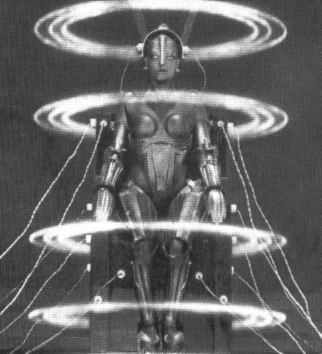 Bladerunner
(1982), which launched a recent cycle of the genre, ends up with all the
women being robots. This is part of the genre’s coldness. The mad scientist
Rotwang in Metropolis starts this with the creation of the robot femme
fatal in a scene that inspired the Frankenstein films. Except for Jean-Luc
Godard's Alphaville (1965) and Lucas' THX 1138, the artificial women are
foreseen as electronic rather than cosmetic genetic or indeed medical creations.
Bladerunner
(1982), which launched a recent cycle of the genre, ends up with all the
women being robots. This is part of the genre’s coldness. The mad scientist
Rotwang in Metropolis starts this with the creation of the robot femme
fatal in a scene that inspired the Frankenstein films. Except for Jean-Luc
Godard's Alphaville (1965) and Lucas' THX 1138, the artificial women are
foreseen as electronic rather than cosmetic genetic or indeed medical creations.