
Today wide-sweeping and creative uses of technology can be initiated by a teenager in their bedroom or by a huge multi-national corporation. It’s as much a matter of brain power as computer power.
To help individuals and companies of all sizes to cope with the expansion of creative industries digital clusters are being formed throughout Britain. They might sound like a chocolate delight for computer nerds but in reality they are organisations that serve to develop links, commercial partnerships and networking for a broad range of creative endeavours - from websites, TV production, radio to music and marketing design.
At the moment there is a network of creative digital clusters that include BRIC, the Bristol Interactive Cluster, Wessex and Gloucester. To join them, on Thursday, November 6, 2003, the Plymouth Media Partnership (PMP) was launched at The Barbican Theatre, Castle Street, Plymouth.
PMP is supported by South West Screen, the South West Regional Development Agency, Plymouth City Council, Carlton Television, and Motiongrafik, Twofour Productions and it’s new media arm twofourtv.
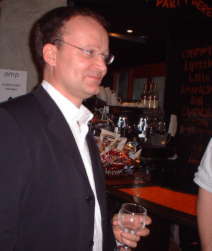 In
the darkened theatre Mark Hawkins the Chief Operating Officer at twofourtv,
and chair of the PMP steering group, opened the proceedings with a short
review of the organisation’s objectives. Ironically, considering the meeting
was about technology, he asked people to switch off their mobiles. Not
surprisingly someone’s mobile did ring later on!
In
the darkened theatre Mark Hawkins the Chief Operating Officer at twofourtv,
and chair of the PMP steering group, opened the proceedings with a short
review of the organisation’s objectives. Ironically, considering the meeting
was about technology, he asked people to switch off their mobiles. Not
surprisingly someone’s mobile did ring later on!
The first guest speaker was Paul Hassan the Business and Development Director for South West Screen, the media agency for the South West funded by the Film Council. He said that it is important to keep creative talent in the region, rather than let them go to London where most creative industries are based. Through help in supporting businesses, funding, training and other initiatives like the PMP he feels that we can buck this trend. In addition, he wants regional companies to make an impact nationally and internationally.
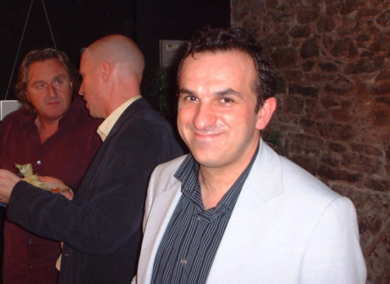 Following
him came Malcolm Brinkworth, the Executive Producer of Touch Productions,
which he founded sixteen years ago, after six years at the BBC. Malcolm
has been the Chair of the Nations and Regions for PACT for the last two
years and is Chair of the Wessex Media Group.
Following
him came Malcolm Brinkworth, the Executive Producer of Touch Productions,
which he founded sixteen years ago, after six years at the BBC. Malcolm
has been the Chair of the Nations and Regions for PACT for the last two
years and is Chair of the Wessex Media Group.
He noted that with new regulations, the role of Ofcom the new communications regulator, and other recent changes, independent producers will be able to retain more rights to their programmes. As a consequence of this they can have more control over their output and will be able to grow their businesses.
In the past three years the BBC has failed to meet its statutory quota of independent productions. In the last year it only filled 21 per cent of it's airtime with independent productions instead of 25 per cent. According to PACT at least 10 per cent of their 1,000 members have left the market due to lack of commissions and low profit margins. Ofcom intends to enforce the 25 per cent rule, and to bring in a new code of practice that will allow producers to keep the rights to their programmes so that they can benefit from selling to other channels in the UK and internationally. The possibility that independent productions will have a far bigger share in the market has already inspired venture capitalists to buy stakes in such companies.
Jane McCloskey, Director of Programmes for Carlton Westcountry and Carlton West, was the next one to step up to the illuminated podium. Her role is to oversee all programme output and development, and she liases with the ITV Network Centre on network commissions. She said that the relation between independents and broadcasters has become increasingly blurred. Westcountry TV in Plymouth has a relatively small team and they want to expand beyond their weekly quota of 8½ hours of regional programming. They want their programmes broadcast on the main ITV network and on such channels as Discovery. For this to succeed independents are vital for their stream of factual programme output. At the moment they are also making a drama programme which is a new development for them. By networking companies and individuals in the Plymouth area she said that we all “reap the benefits. Lets all join forces and really make this project sing.”
As a footnote to this Jane said that the Wessex digital cluster has been very successful in bringing to her attention individuals and companies that can contribute to Westcountry, without them having to go to the usual companies in London or the other main centres of TV production.
 Last
but not least was Anthony Lilley, Managing Director of Magic Lantern Productions,
a broadband interactive media production company. He is also Chairman
of the Interactive Media Policy Group of PACT (The Producers' Alliance
for Cinema and Television), a member of the Advisory Boards of the
Department of Trade and Industry on broadband content and to the Department
of Culture on Intellectual Property.
Last
but not least was Anthony Lilley, Managing Director of Magic Lantern Productions,
a broadband interactive media production company. He is also Chairman
of the Interactive Media Policy Group of PACT (The Producers' Alliance
for Cinema and Television), a member of the Advisory Boards of the
Department of Trade and Industry on broadband content and to the Department
of Culture on Intellectual Property.
He gave an entertaining multi-media presentation during which he confessed he was half luvvie and half geek. He sympathises that computer geeks can be as creative with java script as a luvvie with their scripts and storyboards, however, there is a worrying tendency to be dazzled by computer hardware and geek speak.
He said that too often technology “wags the dog“. To make this point he showed a video he made of an old lady with a robot dog. The robot dog is useless to her compared to a real dog, and in the end she dumps it in a canal. Technology is not always progress and it has to have some sort of meaning or value before it can be of any use.
Another myth he attempted to explode was that all the various media technology would converge. As soon as it seems like it will converge it breaks apart again and he doesn't think it will ever happen. One reason for this is that people use technology for different reasons.
He thinks that technology has to find its own level and this often happens when a newer technology comes along. For example, when TV came along it replaced the cinema as a provider of news, and cinema became the main medium for drama features.
With our current technologies we have the chance to harness and use it’s possibilities in new and exciting forms. Interactivity between the producer and the audience is just one area where changes are occurring. The Big Brother TV show is one rather clunky way of using interactivity, and this is bound to be refined in future.
To summarise, these new forms of technology and content have created a growing and complex chain of people and companies. There is just too much for one person, or even one company, to understand or control, so it makes sense to work together.
Looking at the turn-out for this event - about 100 people - it shows that there is a lot of creative talent in and around Plymouth and that through the Plymouth Media Partnership it is hoped that they will be able to exploit these new possibilities.
LINKS
Membership of the Plymouth Media Partnership is free, details can be found be contacting:
PMP, 9 Branson Court, Plympton, PL7 2WU
Telephone/Fax: 01752 346530
Website: www.pm-p.com
E-mail: karen@pm-p.com
Information about Carlton Westcountry can be found at:
http://www2.itv.com/carltonwestcountry/
|
|