Taking its title and
characters from the Spaghetti westerns of Sergio Leone as its inspiration,
director Robert Rodriguez latest film is both a homage to those classic
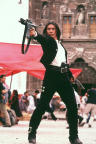
films and a continuation of the adventures of El Mariachi (Antonio Banderas),
which began with El Mariachi (1992) and continued with Desperado
(1995). Like Leone’s Dollars trilogy, these three films fit
together as a series, but can also be seen as stand alone films.
This time, Banderas’ guitar-welding hero gets mixed up in a complicated
scheme to overthrow the Mexican President (Pedro Armendariz Jr.).
This plot involves Sands (Johnny Depp), a renegade CIA agent who plans
to profit on the chaos that a coup would provide. Sands enlists El
Mariachi to kill General Marquez (Gerardo Vigil) who aims to murder the
president with the help of his soldiers. Sands also persuades retired
FBI agent Jorge (Ruben Blades) to assassinate Barillo (Willem Dafoe), a
powerful drug lord who wants to take over from the president. However,
there are also other characters with their own agendas, and very soon there’s
a host of double crosses amidst hails of gunfire and pyrotechnic mayhem.
Like Leone’s Once upon
a Time in the West (1968), Rodriguez plays out this film on a large
canvas. El Mariachi’s quest for vengeance is only one of many plots,
the locations are more expansive and the action set pieces more elaborate.
Some viewers may be disappointed to discover that El Mariachi is not the
focus of the story, as he was in the previous instalments. However,
this also echoes Leone’s earlier film, where Charles Bronson was the mysterious
gunslinger who starts the story off, but who also shared the screen with
Jason Robards and Henry Fonda, whose characters acquired as much significance
as Bronson’s as the story progressed. El Mariachi, like Bronson’s
character, is an avenging angel who finds himself caught up in wider events
around him. However, in addition to the action that we have come
to expect from a Rodriguez film, there are also personal and heartfelt
reasons behind the various characters' actions.
Rodriguez
takes the archetypal characters and situations familiar from Leone’s films
and put a fresh spin on them. Almost everyone in the film’s large
cast gets a chance to shine, particularly Depp as the duplicitous Sands
(who gets a comeuppance of sorts, but who also, by the end of the film,
earns a degree of sympathy). Despite the various physical and emotional
ordeals that the characters go through, this is ultimately a terrific piece
of entertainment and Rodriguez is clearly enjoying himself. There
are sly nods to Leone’s films, along with scenes featuring Rodriguez’s
own macabre sense of humour. There’s also the director’s trademark
furiously edited action sequences, which include El Mariachi’s and Carolina’s
(Salma Hayek’s) hair-raising escape down the side of a building, and a
motorbike sequence that plays like a revved up chase from a western, with
bikes substituted for horses. Unlike the Spy Kids films, which
- understandably - dialled down the frenetic pace, gun-toting action and
slapstick violence that made Rodriguez’s other films so memorable, Once
upon a Time in Mexico brings back these qualities with a vengeance.


 Rodriguez
takes the archetypal characters and situations familiar from Leone’s films
and put a fresh spin on them. Almost everyone in the film’s large
cast gets a chance to shine, particularly Depp as the duplicitous Sands
(who gets a comeuppance of sorts, but who also, by the end of the film,
earns a degree of sympathy). Despite the various physical and emotional
ordeals that the characters go through, this is ultimately a terrific piece
of entertainment and Rodriguez is clearly enjoying himself. There
are sly nods to Leone’s films, along with scenes featuring Rodriguez’s
own macabre sense of humour. There’s also the director’s trademark
furiously edited action sequences, which include El Mariachi’s and Carolina’s
(Salma Hayek’s) hair-raising escape down the side of a building, and a
motorbike sequence that plays like a revved up chase from a western, with
bikes substituted for horses. Unlike the Spy Kids films, which
- understandably - dialled down the frenetic pace, gun-toting action and
slapstick violence that made Rodriguez’s other films so memorable, Once
upon a Time in Mexico brings back these qualities with a vengeance.
Rodriguez
takes the archetypal characters and situations familiar from Leone’s films
and put a fresh spin on them. Almost everyone in the film’s large
cast gets a chance to shine, particularly Depp as the duplicitous Sands
(who gets a comeuppance of sorts, but who also, by the end of the film,
earns a degree of sympathy). Despite the various physical and emotional
ordeals that the characters go through, this is ultimately a terrific piece
of entertainment and Rodriguez is clearly enjoying himself. There
are sly nods to Leone’s films, along with scenes featuring Rodriguez’s
own macabre sense of humour. There’s also the director’s trademark
furiously edited action sequences, which include El Mariachi’s and Carolina’s
(Salma Hayek’s) hair-raising escape down the side of a building, and a
motorbike sequence that plays like a revved up chase from a western, with
bikes substituted for horses. Unlike the Spy Kids films, which
- understandably - dialled down the frenetic pace, gun-toting action and
slapstick violence that made Rodriguez’s other films so memorable, Once
upon a Time in Mexico brings back these qualities with a vengeance.