

'Tis
Herself - A Memoir Maureen O'Hara's autobiography
Frankie
Howerd: Stand-Up Comic
Big Fish
The
Origins of Tolkien's Middle Earth For Dummies®
Anime
Poster Art
Futurama
Comics: Rise of the Machines! is a send up of T3.
Lara
Croft Tomb Raider:The Cradle Of Life. The Official Movie Souvenir Magazine
Virgin
Film: Comic Book Movies
In
All Sincerity…Peter Cushing
Film Art
Retouching
Stalin's Moustache reviewed by Howard Schumann
Excelsior!
The Amazing Life of Stan Lee
Roger
Moore: His Films and Career
and why
not? Barry Norman
Elvis:
A Celebration
E. T. The Extra-Terrestrial
Harold
Lloyd: Master Comedian
Gaslight
Melodrama
New
Chinese Cinema
Mise-En-Scene
Digital
Domain
The
Royle Family
David
Lean
Film:
The Critic's Choice
Burt
Lancaster: An American Life
Dawson's
Creek
Roswell
High
The
Sopranos
Rita
Hayworth: A Photographic Retrospective
Gaslight Melodrama
 From
Victorian London to 1940s Hollywood
From
Victorian London to 1940s Hollywood
Guy Barefoot
Continuum, 2001. Pbk. 212 pages. US $29.95; £19.99. Hbk £60.00.
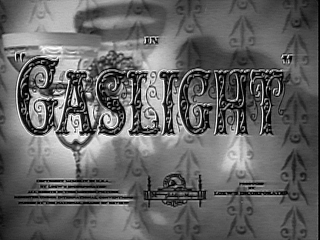
Gaslight Melodrama seems like an esoteric subject for a book but Barefoot shows us how films, theatre and literature have used gaslight as an essential part of their structure. He notes that in the Geirge Cukor's film Gaslight (1944):
Gaslight has an importance within the Hollywood film Gaslight as an element of the period furnishings, as a motivation for the film's 'expressionist' lighting, as a means of heightening suspense, in terms of the convoluted and melodramatic narrative, and a woman's subjective experience.An whole cycle of 'gaslight melodramas' was produced in the 1940s in the USA and Britain. They are not as hard boiled as film noir, but they do address and reflect female/audience fears of the 1940s even though they are set in the 1880s to 1900s.
Gaslight movies combine crime, melodrama and often have a theme where a person tries to convince another individual is going insane. The re-construction of Victorian London in this cycle of films is examined, which is interesting in terms of recent movies about Jack the Ripper (in particular From Hell).
Not an easy read but worth the effort especially if you are interested in period movies, the use of mise-en-scene and the historical context of film productions.
 New
Chinese Cinema
New
Chinese Cinema
Challenging Representations
Sheila Cornelius
with Ian Haydn Smith
Wallflower Press. 2002. Pbk. 134 pages. £11.99.
Mise-En-Scene
Film Style and
Interpretation
John Gibbs
Wallflower Press. 2002. Pbk. 144 pages.
£11.99.
Both of these are from Wallflower's growing Short Cuts series. Mise-En-Scene is a tricky concept specially designed to confuse film students and befuddle the rest of us, so Gibbs' book uses scenes from Rebel Without a Cause and Lone Star to help us understand it.
Digital Domain
The Leading Edge of Visual Effects
Piers Bizony
Aurum. 2001. Large format hbk. £35.00.
This takes an exclusive look at this famous special effects company formed by James Cameron, Stan Winston and Scott Ross in 1993. Full of colour pictures and descriptions of how they got True Lies, Titanic, Apollo 13, True Lies, X-Men, Fifth Element and lots more effects driven movies to our screens. Sometimes it reads like a corporate promo but it's worth it to get such an insight into the workings of such a major special effects producer.
The Royle Family, My Arse, The Best Bits
Caroline Aherne, Craig Cash and Henry Normal
Granada. 2001. Pbk. 143 pages. £9.99.
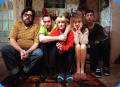
The Royle family live to watch TV and make jokes about bodily functions (farting mainly). They are sink estate, working class, couch potatoes who are at the opposite end of the social scale to The Royal Family (God bless 'em!).
 Here
we get the best bits of dialogue from the first three series. The series
cover the marriage of Denise Royle to Dave Best, her subsequent pregnancy
and the consequences of having an heir to the Royle throne.
Here
we get the best bits of dialogue from the first three series. The series
cover the marriage of Denise Royle to Dave Best, her subsequent pregnancy
and the consequences of having an heir to the Royle throne.
Although nothing much seems to happen in each episode, as you might expect since most of the action takes place as they sit around watching telly, the dialogue is sharp and funny. Its creators would say it reflects the real viewing situation, where the family lives through and in front of that little electronic box; on a more negative note you can see it as taking the piss out of the majority of its own viewers! The later reaction is mainly avoided because the acting and script is so good that you enter their lives and see them as people rather than as loud mouthed stereotypes.
As this book shows it is so well observed and miles away from the majority of refined middle-class 'semi-detached' sitcoms. The Royle family revels in being common; when their teenage son Anthony takes up with a 'posh' girl he tells them that on Christmas Day they will play parlour games at her home. Denise asks "Is their telly broke?" Whilst the Dad in his usual manner comments, "Parlour games my arse. Ey, tell you what you'd be good at, that's if they play it - hunt the giro."
This collection of best bits of script combined with plenty of colour pictures provides an excellent taster for those unfamiliar with the Royle's and a reminder for fans of why it is so watchable.
Dad Royle would say, "watchable my arse, who wants to read a book about a damn telly programme? You watch it on telly, not read it, what's the use? It's like having a shite and then reading about it, one is real the other's just stupid words on paper. Chuck the book away and watch the bloody programme why don't you?" I say buy it and don't listen to him, he doesn't know his arse from his elbow.
David
Lean
An Intimate Portrait
Sandra Lean and Barry Chattington
Andre Deutsch. 2001. Large format hbk.
240 pages. £25.00.
A fitting tribute to David Lean and his films. The pictures here give an insight to his personal life and relate to his impressive movie career. As Spielberg notes "I don't know of one director who doesn't go down on one knee whenever The Bridge on the River Kwai or Lawrence of Arabia is discussed." The other knee should go down for this book.
Film
The Critic's Choice
Edited by Geoff Andrew
Foreword by Bernardo Bertolucci
Aurum. 2001. Large format hbk. 352 pages. £25.00.
In the ten chapters of this volume we
get two-page spreads of the key films from The Silent Era, America, Europe,
British, International and animation cinema. There is a big high-quality
picture from the selected movie on each page and a short credit list, and
list of other films by the director. The text provides an intelligent road
guide to some of the greatest films of the last century. Films such as
King
Kong, The Lavender Hill Mob, Annie
Hall, Alphaville,
Aliens,
and Metropolis are covered.
Burt Lancaster
An American Life
Kate Buford
Aurum. 2001. Pbk. 451 pages. £9.99.
 Troubled
Waters
Troubled
Waters
An Unauthorised and Unofficial Guide to
Dawson's Creek
Scott Andrews
Virgin. 2001. Pbk. 376 pages. £6.99.
 High
Times
High
Times
An Unofficial
and Unauthorised Guide to
Roswell High
Keith Topping
Virgin. 2001. Pbk. 243 pages. £6.99.
Bright Lights, Baked Zitti
The Unofficial, Unauthorised Guide to The Sopranos
David Bishop
Virgin. 2001. Pbk. £6.99.
Rita Hayworth
A Photographic Retrospective
Caren Roberts-Frenzel
Harry N. Abrams. 2001. Large format hbk. 240 pages. £27.00.
In her prime she was the Love Goddess
of Hollywood's Golden Age but in real life she was shy and retiring. Her
film career ran from 1935 (billed as Rita Cansino) to 1972. The many photographs
in this book show her as pin-up, film star and behind the scenes. The pictures
are from the author's own collection and have useful captions linked to
them. Rita will probably be remembered for her role in Gilda (1946)
although she couldn't live up to that film's screen image. She ruefully
remarked "Most men fell in love with Gilda and wakened with me."
|
|